
Learn more about the Olympic Sport of Fencing

Introduction
Attack, touch, and SCORE!
This exciting, elegant sport is fencing. What began as a recreation of real sword fights has now become an organized sport, recognized worldwide. Fencing honors the art of swordsmanship and dueling. Often referred to as “physical chess,” this sport combines impeccable judgement and athleticism. Fencing has been part of the Olympic Games since their inception in 1896, and continues to be one of the most revered sports in the world.
The sport, particularly sabre fencing, is incredibly fast but can be satisfying and enjoyable to watch once one understands the disciplines, rules, and nuances. Let’s explore more fascinating history, weapons, and rules!
History of Fencing
Fencing wasn’t “invented” as a sport. For centuries, monarchs employed sword fighting in wars. However, sword-fighting declined as the world moved to firearms around the 17th century. The decline made the public utilize it as a way to settle disputes and later, as a recreational sport.
So, what is fencing?
The word ‘fencing’ comes from ‘fence,’ which means to defend oneself (defense, that is!). Initially, people would spar each other in alleyways and deserted streets, often to resolve issues or purely for entertainment. Soon, the sport got popular, and rules started to emerge. Fencing was incredibly popular all over Europe, and Italy produced some of the finest players in the 17th to 19th centuries. The Italians also set up several academies and laid down doctrines for the modern fencing system as we know it today.
Rules in Fencing
Fencing competition rules are pretty straightforward. There are two kinds of fencing matches – individual bouts and team bouts with three players on each team. An optional fourth player may be present as a substitute. Generally, individual bouts go to 15 points each. In team events, one fencer from each team fences the first bout until one team reaches 5 points. Then, the fencers rotate and fence the next bout until one reaches 10 points. In subsequent bouts, the fencers continue rotating with each 5-point segment, fencing to 15, 20, 25, 30, 35, 40, and finally, 45.
The first team to reach 45 points wins.
The sparring happens on a strip called the piste, which is 14 meters long and 2 meters wide. The fencers move gracefully, yet swiftly, back and forth along this strip, attempting to touch their opponent with their sword. There are three kinds of weapons in fencing. Let’s discuss these next.
Types of Weapons
Fencing is divided into three disciplines based on the equipment used. They are:
Foil:

An athlete targets the opponent’s upper body. The torso, front or back, is a potential scoring region. Players use only the blade’s tip to strike; a touch from any other part of the blade is not permitted. The weapon is required to weigh less than 500 g.
Sabre:

Sabre fencing, also spelt saber, is the fastest among the three fencing disciplines, and for that reason, it is also considered the most exciting. The sabre can be easily identified by its distinct bell – like “guard,” which covers the handle and protects the fencer’s hand. Athletes use the tip and side of the blade to attack the opponent, targeting the entire body from the waist up: arms, wrist, torso, and head. Like the foil, the sabre must weigh less than 500 g.
Since sabre matches are so fast, the referees must remain sharp throughout. In critical matches, slow-motion action videos help the referees make accurate calls.
Épée:
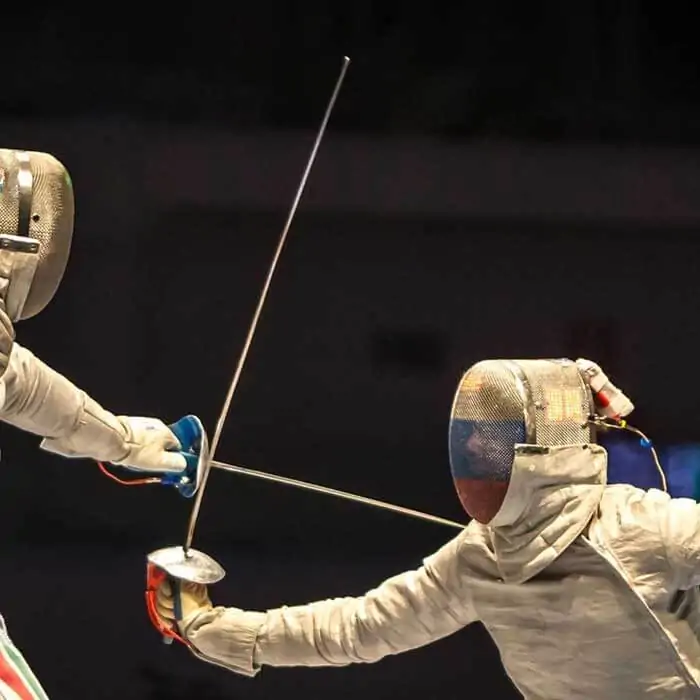
If sabre matches are the fastest, épée matches are the slowest of the three weapons. Some national and international matches can last for hours, too!
Fencers target the opponent’s entire body, from head to feet, using the tip of the blade.
Épées, heavier than foils and sabres, must weigh less than 750 g.
We now know the disciplines, weapons, and targets. How does one score points on a piste in a real match?
How is fencing scored?
Scoring in fencing is quite straightforward. When the tip of the sword (or the side, in the case of a sabre) touches the opponent, one scores a point. The first fencer to reach 15 points is declared the winner. Simple, right?
Well, not quite. While this is the central premise and aim of a fencing point system, a few other rules determine who gets the point. So, what is fencing scoring really like?
Fencing is scored electronically. Each fencer is assigned a light—red or green. When one goes on the offensive and touches the opponent successfully, a light appears on the score box, and a point is scored. This aggressive move is an “attack.” However, the defender can earn the point by blocking the attacker’s blade with a move called the “parry” and then making an immediate touch on the attacker, a motion called a “riposte.”. These are the principal moves in a fencing match.
An additional element in sabre and foil fencing is “Right of Way.” When fencers attack each other simultaneously, both lights go off, and the referee must decide, based on the fencers’ speed and motions, which one “wins the attack” and gets the point. The fencer with the more aggressive stance is rewarded for their initiative. Or, the referee might call “simultaneous” if the fencers’ movements toward the center of the piste are indistinguishable. No point is awarded. The right of way does not apply to epee fencing. If both fencers touch each other simultaneously, both get a point. Ties are broken with an extra touch. Because epee fencing is slow, it is always timed, and if neither player initiates an attack within the first minute, both are penalized, a consequence of the “unwillingness to fight” rule.
Safety protocols
Fencing weapons are sporting equipment; they are not designed to inflict injury. Fencing is not dangerous. Injuries are no different from those commonly sustained in other sports; bruises or strains, for example. Several rules ensure that safety is always of paramount importance.. Fencers are required to wear protective layers made up of the following components:
- Socks, which cover the legs up to the knees
- Shoes that help maintain balance while protecting the feet.
- Breeches or knickers that cover the fencer from the knee to the waist
- A plastron that is worn under the jacket to protect the underarm of the sword arm
- A chest protector, a piece of heavy plastic that covers the breast area, is mandatory for female fencers of all ages. It is optional for male fencers.
- A jacket that thoroughly covers the arms, torso, and neck.
- Gloves are used to improve grip and protect the weapon’s hand.
- A mask that covers the head entirely and has a bib to protect the neck as well
- A lamé is a light layer made of an electrically conductive material. This is worn over the jacket as a vest by foil fencers or a second jacket by sabre fencers so that touches are registered on the scoring box. Epee fencers do not wear lamés, since the whole body is the target. TInstead, touches are registered electronically by a spring-loaded button at the tip of the epee.
Conclusion
Fencing combines intelligence and athleticism–and it’s fun! It has come a long way from its origins in medieval Europe, to its refinement in Italy, to the popular and well-respected sport it is today. It has produced international champions, high-achieving collegiate athletes (fencers go to good colleges!), and thousands of recreational fencers. Fencing is great for both body and mind. Come learn this beautiful sport with us at Manhattan Fencing Center!
Frequently Asked Questions
1.What is it called when you score a point in fencing?
A point in a fencing match is also called a ‘touch.’ You will frequently hear fencers use the French term “touché.” This is because fencers score points when they touch their opponents’ target area.
2.What are the rules of fencing?
In the simplest terms, fencers, regardless of weapon, score points by touching the opponent without getting touched themselves. Sometimes the person who begins the attack and moves toward the opponent first wins the point. However, the defender can win the point by devising a strategy to thwart the attacker’s plan.
Fencing is scored electronically, and each bout is overseen by a referee whose word is final. At the beginning of the bout, each fencer hooks up to a piece of equipment that forms part of an electric circuit. Touches are relayed to a score box. One fencer will have a green light; the other a red light. If one light goes off, assigning the point is easy. When two lights go off, things get a little more complicated. In foil and sabre fencing, the referee determines which fencer has earned “the right of way” or “priority.” As the two come toward the center of the strip or piste, the referee has to determine which of them earned the point, a decision based on each fencer’s speed and movements. Or, the referee determines neither wins a point because their actions were “simultaneous.” Epee does not have the right of way–if there are two lights, each fencer scores a point. Sometimes, epee fencers must fence an additional point to break a tie. Based on a coin toss, the referee will give “priority” to one of the fencers. Two lights again? The fencer with priority wins.
3.Is fencing safe?
Fencing is a safe sport, since fencers wear layers of protective gear, including a hard mask with an impenetrable metal mesh protecting the face. The rules also stipulate safe use of fencing equipment. Fencers who do not adhere to these rules can be removed from competition.
4.What is the cost of fencing equipment?
Many clubs will lend equipment for a set period while beginners try the sport. Fencing equipment is priced at different levels, based on materials used, and while it is not inexpensive, it is durable and does not have to be replaced frequently. For young children, buying uniforms that leave room for growth is best. Beginners might start with a mask, a glove, and a weapon. Similarly, the most basic “whites,” knickers, and jacket, can be purchased for beginners. As fencers become more proficient and compete regionally, nationally, and perhaps internationally, they require higher-quality equipment.